
New lighting and furnishings helped pupils concentrate better
The way a classroom is lit and furnished has a significant impact on pupils’ ability to focus on their learning. This is shown by a new study from the University of Gävle, in which researchers altered the classroom environment at two Swedish lower secondary schools.
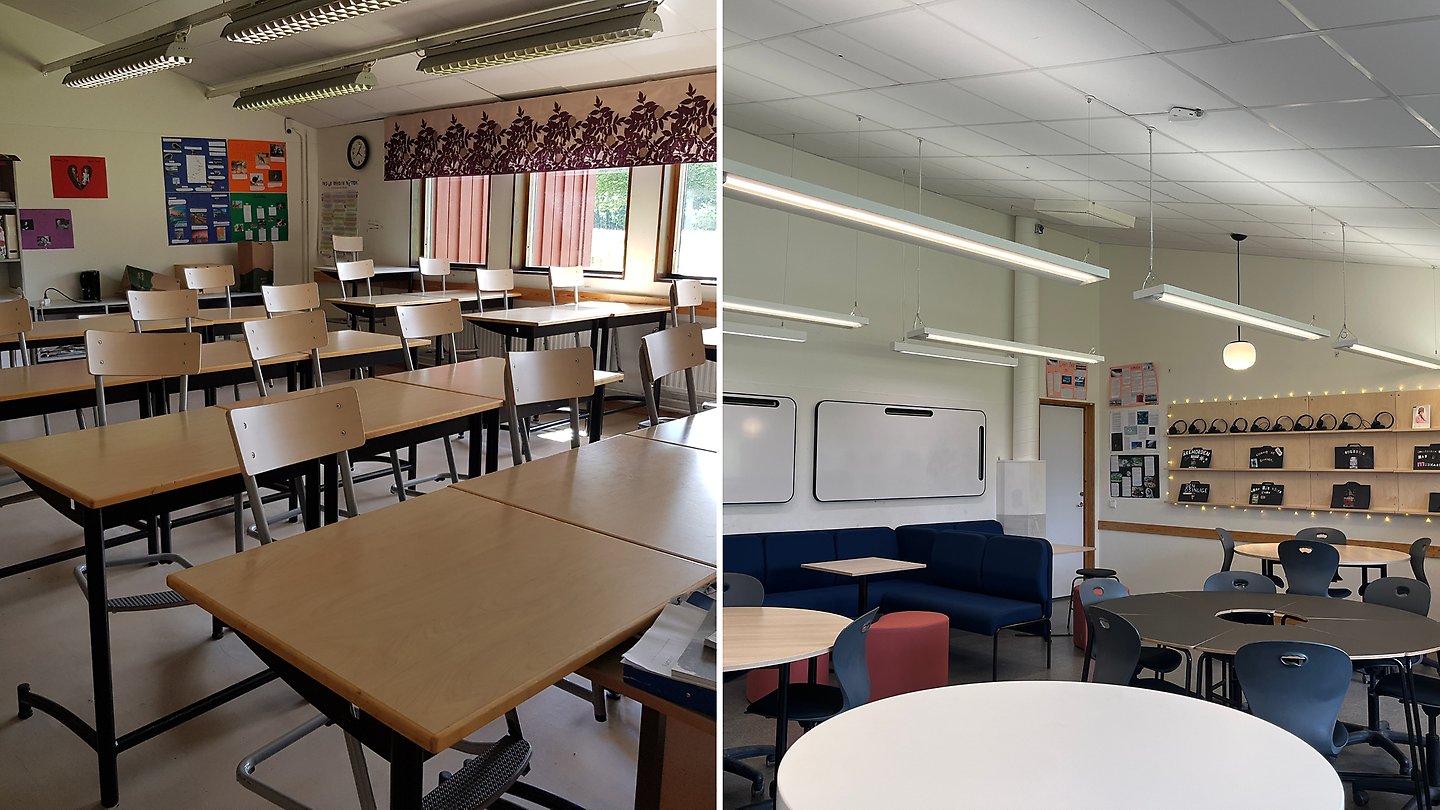
Klassrummen som de tidigare såg ut (till vänster), och med nytt möblemang och ny belysning (t.h). FOTO: Högskolan i Gävle
Over the course of one academic year, Year 9 pupils were taught in classrooms where researchers gradually introduced new lighting and flexible furnishings. The pupils felt that their concentration and learning improved in the modified classrooms. When they returned to their old classrooms, their results deteriorated, only to improve again when the new lighting and furnishings were combined. No corresponding changes were observed in the control classrooms.
“We see strong evidence that the physical learning environment made a difference to pupils and teachers. This study shows how important the physical environment is for teaching and learning,” says Anneli Frelin, Professor of Didactics at Gävle University.
Group tables and screened-off workspaces
The new layout involved replacing heavy tables and chairs with, amongst other things, round group tables, height-adjustable tables, chairs on castors, sofas and screened-off workstations. Different zones were created for group work, individual work and reading.
At the same time, new lighting was installed, featuring both direct and indirect light, specialised lighting for walls and the blackboard, and pre-set lighting scenes that the teacher could adapt for activities such as lessons, independent study and presentations.
The teachers also found the new interior design and lighting to be an improvement. They described how the atmosphere amongst the pupils improved, and how they gained greater pedagogical opportunities in their teaching, thanks to both the lighting scenes and the interior design. The flexible layout made it easier to move around the room, to work in groups and to get closer to the pupils. The lighting was perceived as more pleasant, and the pupils’ previous complaints – including headaches – decreased.
“Easier for the teachers”
“The environment made it easier for teachers to work as they wished. They were able to meet pupils at eye level, create different work zones and adapt the classroom to suit various activities,” says Jan Grannäs, associate professor of didactics at Gävle University.
The study did not investigate whether the changes led to better academic results or higher marks. However, the findings show that the physical environment of the classroom influences perceived focus on learning and supports varied teaching methods.
About the study
The study was carried out during the 2024/25 academic year at two Swedish lower secondary schools and is based, amongst other things, on 1,240 pupil questionnaires, 354 teacher logs and 16 teacher interviews. The project was carried out by researchers at Gävle University of Applied Sciences in collaboration with international researchers from the University of Melbourne and Edith Cowan University, and the companies Fagerhult and Lekolar. It was funded as part of a KK-HÖG project.
Kontaktperson


Sidan uppdaterades 2026-09-30